The key difference is one relates to water and the other usually relates to soil.
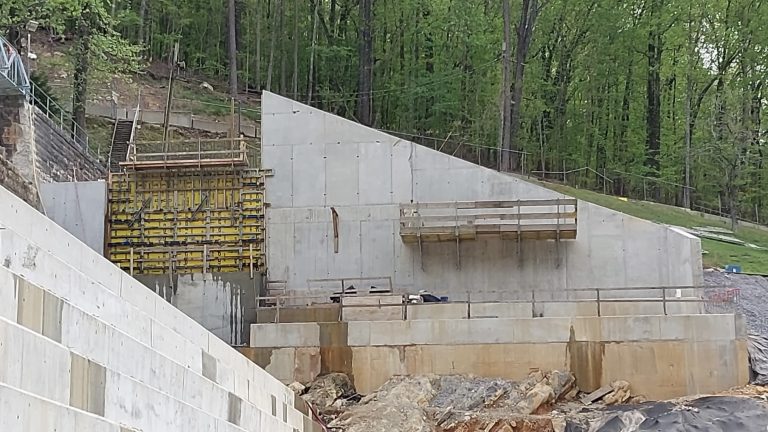
Our recent social media posts about the construction of a training wall at Lake Purdy Dam generated comments asking if we meant to say “retaining wall” or if autocorrect got the best of us. While we appreciate our followers looking out for us, the correct term, in this case, is training wall.
To clear up the confusion and help our customers better understand our work, we thought it would be helpful to talk to one of our engineers about the difference between training walls and retaining walls. The key difference is one relates to water and the other usually relates to soil.
Retaining walls are more common and most people probably see them every day.
“A retaining wall is doing that very task, it retains something,” said Matt Rocksvold, an engineer for Central Alabama Water (CAW). “If your yard is sloped, you can build a wall and bring soil in and back fill to that wall so that is retaining earth or soil, and you have a flat yard.”
Training walls, like the ones CAW is constructing at Lake Purdy Dam, are used around dams and other water sources, but are not as widely known or understood by the public.
“I think of it like training wheels,” Rocksvold explained. “The training wall is guiding or training the water along a certain path the engineer wants it to go on. It can stop erosion. It can stop the force of water causing damage. At Lake Purdy we’re training the water to go down the spillway and not to go over the side of the dam or on the banks. Ultimately, a training wall keeps erosion from occurring and directs water where you want it to go.”
Rocksvold says every dam has an outlet for water and uses training devices such as walls or weirs to direct the flow.
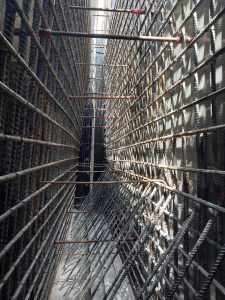
While the training walls and retaining walls serve different purposes, both must be designed and built to withstand the forces of either the water they control or the earth they’re holding back. Rocksvold said both types of walls will contain reinforcement and a strong footing.
So, the next time you see a wall near a dam, river or another body of water, look closely. What you think is a retaining wall may be a training wall directing the flow of water.